The last working tea plantation in Europe, growing on São Miguel since 1883. Free factory tour, tasting, field walk, and how to combine with a Furnas day.
Gorreana is the last working tea plantation in Europe. The Mota family has been growing and processing tea on this hillside above Maia, on São Miguel’s north coast, since 1883. They use the same Victorian-era machinery the original founders imported from England (you can hear it running through the factory floor), and they sell the result by the packet in a small shop next to the visitor entry.
The visit is free, takes between 45 minutes and 3 hours depending on what you want, and is a logical add-on to a Furnas day. This guide covers what you actually see, the field walk most visitors skip, and how to combine the stop with the rest of the eastern circuit.
What the visit includes
The estate has three components, and they are all open to the public without an appointment.
The factory. A working production floor with the original 1883 machinery still in daily use. You walk through on a self-guided path behind a low rail. You see the leaves arriving from the field, the withering troughs, the rolling drums, the oxidation room, and the drying ovens. A short film loop in English explains each step. Free.
The tasting room. A counter at the end of the factory where you sample three of the house teas (typically a green tea, the Orange Pekoe black, and the Broken Leaf black). Free. Buy a cup of brewed tea (€1.50) if you want to sit with it on the terrace.
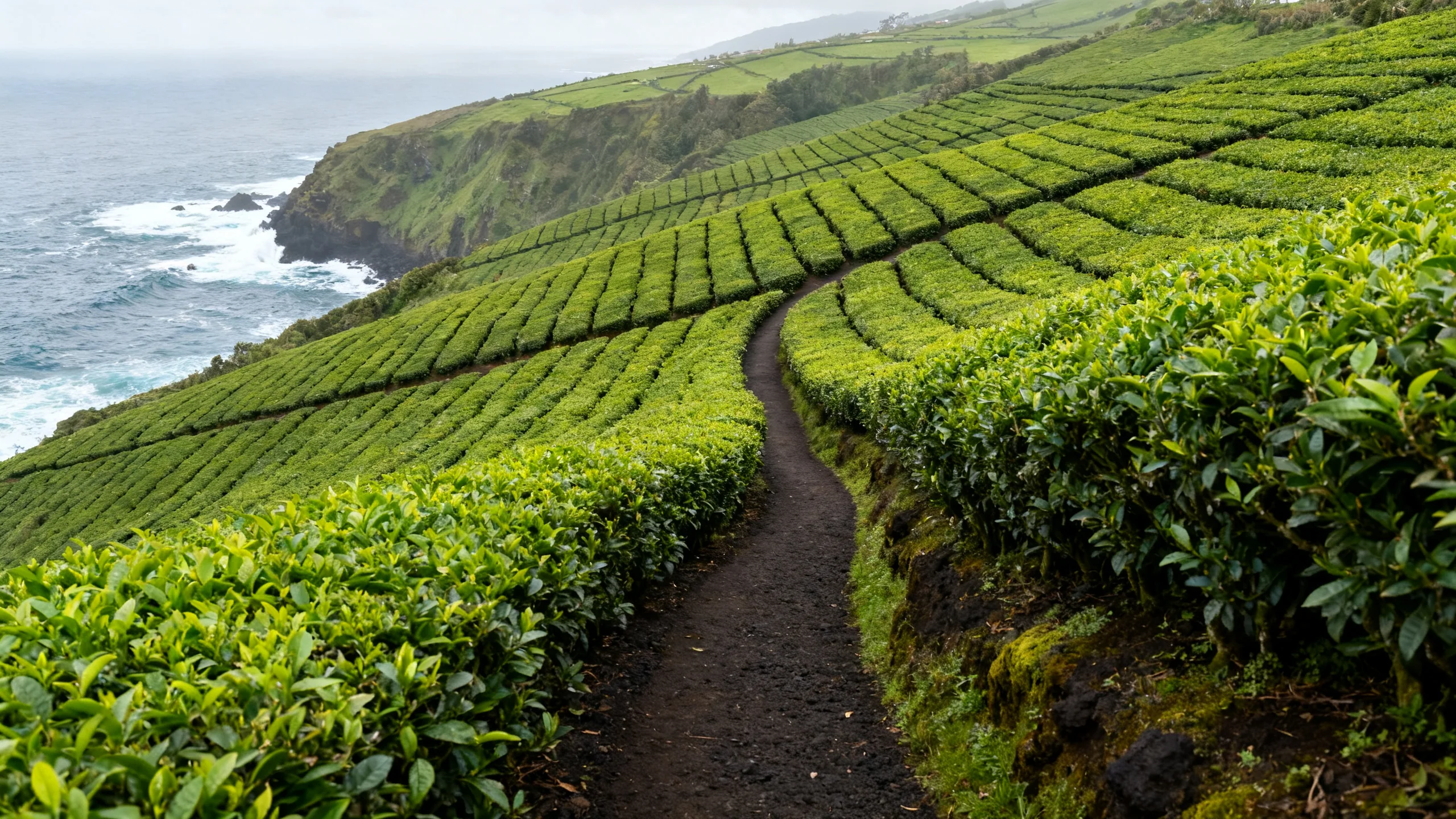
The field walk. The trail loops out from the visitor centre, drops through the lower tea fields, climbs back up along the hedge of an older planting. About 2 kilometres on a wide grass path. Most visitors skip it. They are wrong to.
The shop sells the tea by the 100 gram packet (€2 to €5 depending on grade). Cash and card both accepted. A 200 gram tin of the higher grades, Pekoe and Broken Leaf, is the standard buy-home gift.
Why the field walk is the point
Most coach-tour groups stop for 30 minutes at the factory, taste the tea, buy a packet, leave. They miss the part that makes the visit distinctive.
The fields drop towards the cliff and the Atlantic. You walk between shoulder-high tea hedges with the wind running through them, the ocean three kilometres downhill, and almost no one else around. In spring, when the new shoots are coming through, the green is genuinely vivid. In autumn, it is camellia-flower season and the older plantation rows are dotted with pink and white blooms (the tea bush is Camellia sinensis, the same genus as ornamental camellias).
Allow an hour for the loop, including stops. A short, easy, properly beautiful walk.
The history, in one paragraph
In 1883, the Mota family imported tea bushes from Macao and a Chinese tea-master to set up production. The estate ran continuously through the 20th century while the rest of European tea production disappeared (the African plantations took over the commodity market after 1950). Today, Gorreana and the neighbouring Chá Porto Formoso, both on the same north-coast strip, are the only two working tea plantations in Europe. Gorreana is the larger of the two and the only one with the original equipment still in production use.
Practical details
The estate sits on the EN1-1A coastal road, 17 kilometres east of Ribeira Grande, 8 kilometres west of Nordeste. There is a car park opposite the visitor entry, free, never full.
| Item | Detail |
|---|---|
| Address | Plantações de Chá Gorreana, Maia, 9625-304 Ribeira Grande |
| Hours | 9am to 6pm daily, year-round |
| Entry | Free (factory, tasting, field walk, shop) |
| Cup of tea | €1.50 at the counter |
| Packets to buy | €2 to €5 for 100 g, €7 to €12 for 200 g tins |
| Time needed | 45 min minimum, 2 to 3 hours with the field walk |
| Cards | Accepted, contactless works |
How to combine the stop
Gorreana is on the EN1-1A north-coast road, which is also the most scenic route from Ponta Delgada to Furnas. The natural day-trip is the eastern circuit: PDL → Ribeira Grande → Gorreana → Furnas → back via the southern road.
The flagship guided day
The Furnas Volcano and Tea Plantation tour with lunch is the highest-rated combined option (4.9 with 402 reviews). Around €80, 8 hours. Picks you up at your hotel, covers the cozido lifting at Furnas, a Gorreana stop, lunch, and the Lagoa do Fogo viewpoint on the way back. Best for travellers without a car.
The fuller tea-focused day
The Furnas tea, lake and volcano guided tour gives a longer stop at Gorreana, including the field walk, and combines it with the Furnas valley. Around €70, 4.8 rating.
The DIY option
Rent a car from PDL. Stop at Gorreana between 9am and 10am on your way to Furnas, do the factory and field walk in 1.5 hours, arrive in Furnas for the cozido lifting at 11:30am. The drive from Gorreana to Furnas is 30 minutes through the eastern mountains, one of the best short drives on the island.
Frequently asked questions
Is the tea actually good?
The blacks (Orange Pekoe, Broken Leaf, Pekoe) are good honest table tea. Not boutique, not artisanal, but cleanly grown and properly processed. The Hyssop Green is more interesting (lower oxidation, mild grassy notes). The green tea is the most divisive: people who drink Japanese sencha find it thin. Buy a 100 g packet of each black grade and the Hyssop Green, brew at home, decide what you like.
Are the tours guided?
The factory visit is self-guided, with explanation boards in English and Portuguese and a short film loop. Staff are on hand for questions at the tasting counter. A formal guided tour (1 hour, in English) is available by appointment for groups of 6+, contact the estate directly via gorreana.pt. For independent visitors the self-guided walk is enough.
Can I see the harvest?
The picking season runs April to September, peaking in May and June. The estate uses a wheeled mechanical harvester (you may see it in the fields) plus hand-picking for the higher grades. Production runs year-round in the factory, processing the harvested leaves over several weeks, so the machinery is interesting to watch any month of the year.
Is Chá Porto Formoso worth the extra stop?
Chá Porto Formoso is the second tea estate, 3 kilometres west of Gorreana on the same coastal road. Smaller operation, more recently restored (the family reopened it in 2001 after a 30-year pause). The tea is generally rated below Gorreana, but the visitor experience is more curated, with a small museum and a tea-tasting room. Worth a 30-minute stop if you have time, skip if you do not.