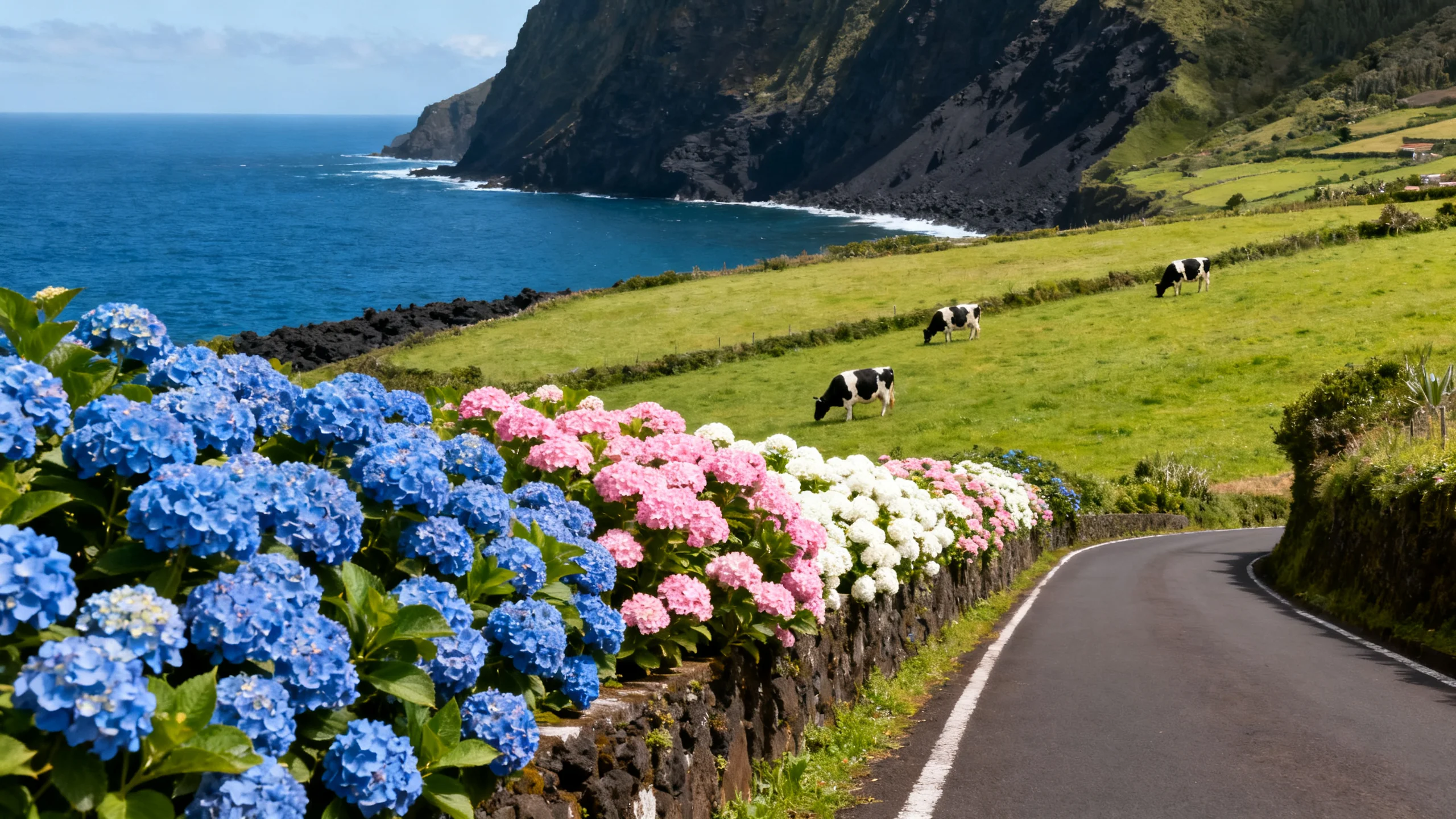
The Azores has no bad month, but each one trades something for something else. Weather, crowds, prices, what is in season, and the months that genuinely deliver.
The Azores has a maritime climate moderated by the Gulf Stream. The practical effect is that nothing is ever cold (lows of 12 °C in February), nothing is ever hot (highs of 24 °C in August), and it rains a bit every month. There is no bad time to come, only different trade-offs.
This guide walks through the year and tells you what each month actually gives you, with the honest downsides. If you want a single recommendation, jump to the bottom.
The climate, in two paragraphs
The archipelago sits at 37 to 39 °N latitude (about the same as Lisbon or San Francisco) but the Gulf Stream and the open Atlantic narrow the seasonal range. Summer highs rarely exceed 26 °C even on the hottest days. Winter lows almost never drop below 10 °C, and freezing temperatures occur only on the volcanic summits.
Rain is more even through the year than at most European destinations. June, July and August are the driest months, with 4 to 6 wet days per month on the south coast of São Miguel. November to February are the wettest, with 14 to 18 wet days. The wet days are rarely all-day washouts; the typical pattern is a fast-moving rain band followed by sunshine within hours.
Month by month
January
Highs: 16 to 18 °C. Lows: 11 to 13 °C. Sea: 16 °C.
Quiet, cheap, rainy. Whale watching is winter-paused for the big species (the spring migration starts in March). Hydrangeas dormant. Most camellias in flower at Terra Nostra garden. Half of the restaurants and several hotels closed in the smaller islands. Good for hot-spring soaking, bad for hiking the higher trails (weather-dependent). Flights at their cheapest of the year.
February
Similar to January but with the year’s brightest days mixed into the average. Almonds in bloom across Santa Maria. Carnival in Terceira (usually February or early March) is the best cultural event of the calendar. Otherwise the trade-offs are the same as January.
March
Highs: 17 to 19 °C. Sea: 16 to 17 °C.
The pivot month. First blue whales and fin whales arrive on their spring migration (the only place in Europe with reliable sightings). Days start lengthening. Hydrangeas waking up. The most reliable month for storm-watching from cliffs. Prices still off-peak.
April
Highs: 18 to 20 °C. Sea: 17 °C.
The first reliably comfortable month. Peak baleen-whale migration (blues, fins, sei). Wildflowers across the island, including endemic species. Hiking trails fully open. The hydrangeas are not flowering yet but the green is at its most vivid. Easter holiday demand pushes fares up for a 10-day window.
May
Highs: 19 to 21 °C. Sea: 18 °C.
The objectively best month for most travellers. Spring whales still passing through, sea warm enough for water activities, weather mostly stable, hydrangeas starting in the higher altitudes. Days 14 hours long. Prices still below peak. May is when locals tell their friends to come.
June
Highs: 21 to 23 °C. Sea: 20 °C.
Hydrangea season starts properly. Sperm whales now resident (year-round). Sea genuinely warm. The first week of June is still shoulder-pricing, the last week is approaching peak. Daylight 14.5 hours, the longest days of the year. Almost no rainy days.
July
Highs: 23 to 25 °C. Sea: 22 °C.
Peak season starts. Hydrangeas at their full bloom along every road on São Miguel, Faial, and Flores. Sea warm enough for unlimited swimming. Day-tours sold out a week in advance. Prices high. Cruise ships arrive at Ponta Delgada. The Festas do Espírito Santo run through June and July, the biggest religious-cultural events of the year. Some travellers love the busy energy; others find it crowded compared to the rest of the year.
August
Like July, but more so. The highest visitor numbers of the year (the Portuguese mainland holiday peak overlaps with foreign tourism). Best weather statistically (lowest rain probability, warmest sea). Prices at their highest. Reservations needed for restaurants in Furnas and Ponta Delgada. Whales good, hydrangeas starting to fade in the second half. Going then is a fine choice if you book early.
September
Highs: 22 to 24 °C. Sea: 22 °C (still its summer peak, warms slowly, cools slowly).
The other objectively best month. Crowds gone after the first week of September, water still warm, weather stable, prices dropping by 20%. The Atlantic spotted dolphins are still around. Hydrangeas finished but trail flowers still good. If you cannot do May or June, September is the answer.
October
Highs: 20 to 22 °C. Sea: 21 °C cooling.
The shoulder month sweet spot for budget travellers. Most things still open, sea still swimmable, weather more variable (the first autumn storms can arrive late in the month). Cumulus skies for photographers. Prices well below summer. The grape harvest on Pico and Graciosa runs late September to early October, worth a stop if wine is in your itinerary.
November
Highs: 18 to 19 °C. Sea: 19 °C.
The first winter month, often underrated. Days still 11 hours. Weather genuinely variable: sunny windows and rain bands within the same day. Most attractions still open, but smaller islands lose half their restaurants. The All Saints (1 November) and feasts of Madeira-Azores diaspora bring a quiet local crowd back. Best for travellers who want quiet rather than warm.
December
Highs: 17 to 19 °C. Sea: 18 °C.
Quiet, mild, festive. The Christmas markets in Ponta Delgada are small but charming. Weather is hit-or-miss week by week. Hot-spring bathing in Furnas is at its best (warm pool, cool air, no crowds). Flight fares low except around the 23rd to 30th when the Azorean diaspora returns for the holidays.
What I would actually book
| If you want | Pick |
|---|---|
| All-round best week | Last week May or first week June |
| Hydrangeas at peak | First two weeks of July |
| Whale migration spectacle | April |
| Best price-to-quality ratio | Second half of September |
| Hot springs + quiet + cheap | November or first half of December |
| Storm-watching and dramatic seas | January or February |
| Carnival | Late February, varies by year |
| Long days, summer feel, low prices | Mid-June or first week of September |
Frequently asked questions
Is the weather reliably bad in winter?
No. Winter is variable. You can get a week of grey rain or a week of brilliant clear days, sometimes both inside the same week. The average is around 15 wet days in a 30-day month (so half the time) but the wet is rarely all-day. Pack a waterproof jacket and good shoes, plan flexible outdoor days, and you can have a great winter trip.
When are the hydrangeas in bloom?
Late June through early August, peaking the first two weeks of July. São Miguel, Faial and Flores have the biggest displays, lining country roads as natural field-divider hedges. They start fading mid-August. The deep blue colour is from the volcanic acid soil, which is why Azorean hydrangeas are bluer than mainland ones.
What about the Atlantic hurricane season?
The Atlantic hurricane season runs June to November, peaking September. The Azores is on the northern edge and gets the tail of maybe one or two systems per year, usually as a deep low rather than a hurricane proper. The local emergency system flags days ahead and flights reschedule. In 25 years, a few storms caused real disruption (Hurricane Ophelia 2017, Lorenzo 2019). The chance of your trip hitting one in any given week is small.
Is the sea warm enough to swim outside July to August?
For locals, June to October. For most northern European visitors, mid-June to end of September. The Atlantic temperature lags the air by a month or so, so September has the warmest water of the year on average. May and October are swimmable for the hardy, especially inside sheltered crater pools like Vila Franca islet.
Are there fewer tourists in the smaller islands?
Considerably fewer, even in peak summer. São Miguel takes 80% of the international traffic. Faial and Pico see a steady summer crowd of sailors and central-group tourists. Santa Maria, Graciosa, Flores and Corvo remain genuinely sleepy year-round. If you want the archipelago without the crowds, even peak August on Santa Maria feels like off-season on São Miguel.