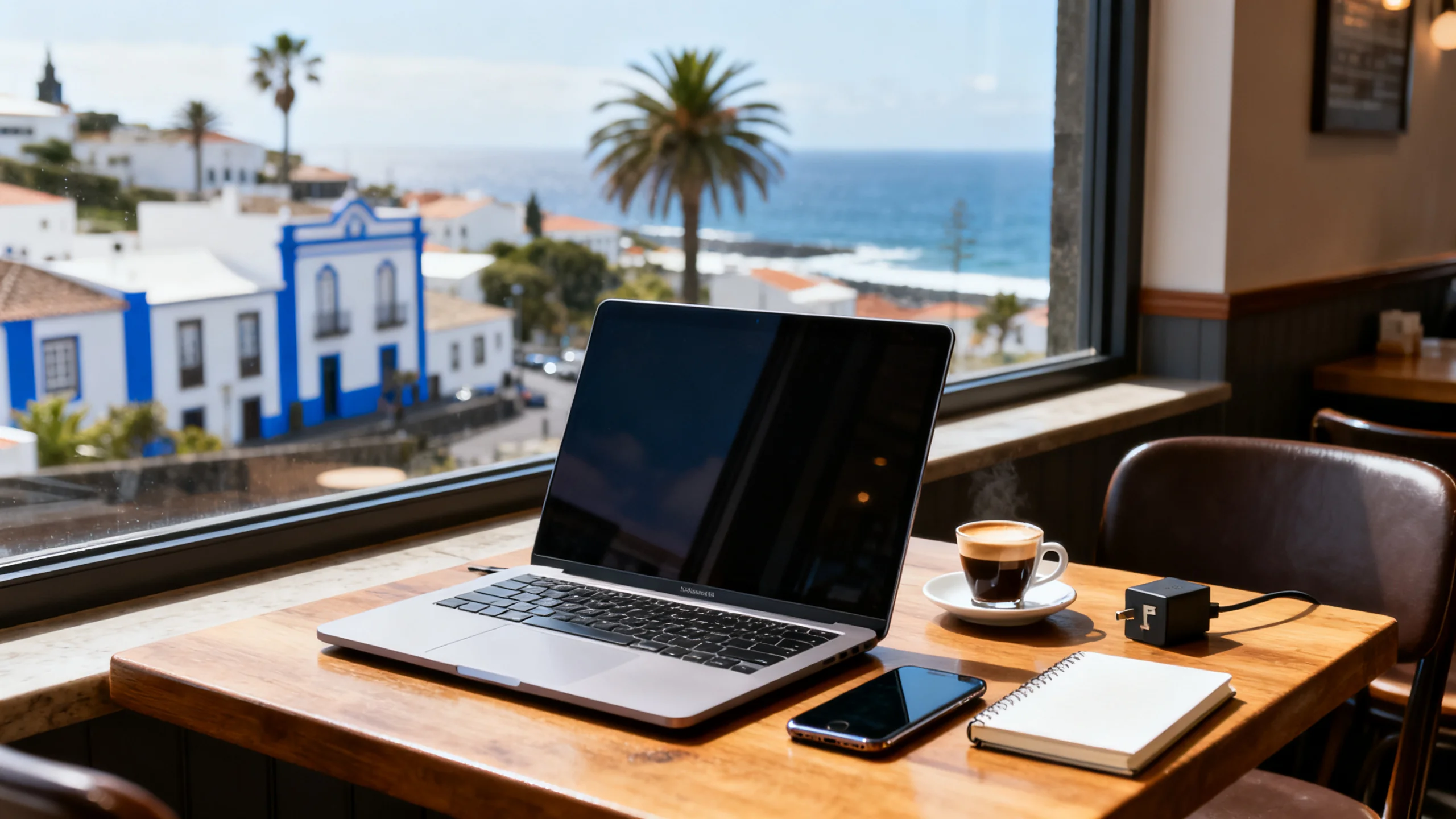
EU plugs and voltage, 4G and 5G coverage island by island, the three Portuguese SIM cards worth considering, and the wifi reality in rural cottages.
The Azores is part of the European Union and runs on European electrical and telecom standards. Plugs are the Schuko Type F, the voltage is 230 V, and the mobile network is operated by the same three Portuguese carriers as the mainland. None of this is exotic.
This guide covers what to bring for power, the practical SIM card options for non-EU visitors, the wifi reality on the smaller islands, and the small things that catch out travellers from outside Europe.
Electricity
Portugal, including the Azores, uses the Continental European standard.
| Item | Spec |
|---|---|
| Voltage | 230 V |
| Frequency | 50 Hz |
| Plug type | Schuko Type F (two round pins, side earth) |
| Compatible plugs | Type C (two round pins, no earth) |
| Power outlets | 1 to 3 per room typical in older hotels |
Travellers from the EU. No adapter needed. All EU plugs fit.
Travellers from the UK. A Type G to Type F adapter is the single item to pack. Available at any luggage shop for €3 to €8.
Travellers from North America. A Type B (US) to Type F adapter plus a check that your device accepts 230 V. Modern laptop chargers and phone chargers handle 100 to 240 V automatically (check the label: “100-240V” is universal). Hair dryers, curling irons and electric shavers built for 120 V will burn out at 230 V without a voltage converter, which is heavy and rarely worth packing. The practical answer: use the hotel hair dryer.
Travellers from Australia, New Zealand, South Africa. Type I or M to Type F adapter. Voltage is the same (230 V), so no converter needed.
Internet and mobile coverage
The Azorean mobile network is operated by three Portuguese carriers, all running on the EU roaming framework.
| Carrier | Strongest on | Notes |
|---|---|---|
| MEO | All nine islands | Strongest overall, best 5G rollout |
| Vodafone | São Miguel, Terceira, Pico | Good on the main islands |
| NOS | São Miguel, Terceira | Cheaper plans, narrower coverage |
4G coverage is excellent across all populated areas of every island. Even Corvo (430 residents) has 4G in the village. The only weak spots are the higher altitudes of Pico volcano, the deep caldera trails, and a few remote coves.
5G coverage is live in Ponta Delgada (São Miguel), Angra do Heroísmo and Praia da Vitória (Terceira), and partial in Horta (Faial). The rest of the archipelago is still 4G.
Speed. 4G typically delivers 30 to 80 Mbps download in towns, 10 to 30 in rural areas. 5G in PDL hits 200+ Mbps. More than enough for streaming, video calls, and any remote-work use.
SIM and roaming options
EU and Schengen travellers
EU “roam like at home” applies. Your home SIM works in the Azores at your normal domestic rates with no surcharge. The 90-day fair-use cap exists but is rarely relevant to a holiday traveller. This is the practical answer for any EU visitor.
UK travellers (post-Brexit)
UK SIMs no longer automatically include free EU roaming. The four big UK carriers handle it differently:
- EE, Vodafone and Three charge daily roaming fees of £2 to £4 per day in 2026, sometimes included in higher-tier plans.
- O2 still includes EU roaming on most plans up to a 25 GB monthly cap.
- GiffGaff, Smarty, Voxi mostly still include EU roaming.
Check your specific plan before flying. A 2-week trip at £3.50 a day is £49 for one phone, which can be worth a swap to a local SIM.
Non-EU travellers
Three practical options.
Option 1: roaming with your home carrier. Convenient but expensive (€5 to €15 per day with US carriers, often capped at low data). Fine for a short trip if you barely use mobile data.
Option 2: a Portuguese prepaid SIM. €10 to €20 for a SIM with 5 to 15 GB of data, valid 30 days. Buy at Worten or FNAC in the airport mall (PDL), or at any MEO, Vodafone or NOS shop in the city. Bring your passport for registration (mandatory). The activation takes 5 to 30 minutes.
Option 3: an eSIM. Airalo, Holafly and similar services sell data-only Portuguese eSIMs for €5 to €30 depending on size and duration. Install before flying, activate on landing. No physical SIM swap. Best for travellers with eSIM-capable phones (iPhone XS+ and most modern Android).
The right answer for most non-EU travellers: an eSIM if your phone supports it, a physical Portuguese SIM if not.
Wifi reality
Wifi is reliable in the main towns and most accommodation, less so in rural cottages on the smaller islands.
Hotels and city guesthouses. Wifi is standard, generally acceptable speed (10 to 50 Mbps). Most hotels do not charge.
Rural cottages and turismo rural. Wifi is usually present but slower (2 to 10 Mbps) and sometimes shared with the next cottage. A backup 4G data plan is wise if you need to work remotely.
Cafés and restaurants. Most central-town cafés offer free wifi. Ask at the counter for the password (“Qual é a senha do wifi?” / “What is the wifi password?”). Coverage in rural village cafés is patchy.
Co-working. Two co-working spaces operate in Ponta Delgada (Nonagon, AzoresJoy). Day passes are €15 to €25. The fast wired internet (200+ Mbps) is the practical use case.
What to bring
Minimum kit for an EU visitor:
- Phone, laptop, chargers
- Power strip if you have multiple devices and the hotel has only two outlets per room
For a UK visitor, add:
- Type G to Type F adapter
For a North American or other non-EU visitor, add:
- Type B (or your country’s) to Type F adapter
- Check 230 V compatibility on every charger before plugging in
- An eSIM or a plan to buy a Portuguese SIM on arrival
Frequently asked questions
Can I use my US laptop charger safely?
Almost certainly yes. Look at the label on the brick: if it says “100-240V, 50-60Hz”, it is dual-voltage and only needs a plug adapter. Practically every modern laptop, phone charger, camera charger, and electric toothbrush is dual-voltage. The exceptions are older hair tools, some travel kettles, and a few specialty medical devices.
Is the wifi reliable for video calls?
Yes in towns and main-island accommodations, often the hotel wifi will run a Zoom call fine. The smaller-island rural cottages can struggle with sustained video calls; have a 4G hotspot on standby as backup. Co-working spaces in Ponta Delgada are the reliable answer for serious remote work days.
Are there power cuts?
Rare. The grid is mostly geothermal on São Miguel and Terceira, diesel and renewables on the others. Short outages (under an hour) happen perhaps two or three times a year per island, usually after storms. Hotels typically have backup generators.
Can I tether my phone for laptop work?
Yes. Tethering is allowed on all Portuguese SIM plans without restriction. 4G tethered speeds are around 20 to 60 Mbps in town, which is enough for any normal work day. 15 GB of monthly data is roughly 30 to 50 hours of moderate office work.
Where can I print or photocopy?
Most hotel reception desks will print a boarding pass for free. For more substantial printing, the Lojas dos CTT (post office) in PDL and Angra offer self-service stations. The library in Ponta Delgada (Biblioteca Pública de Ponta Delgada) has free wifi and public computers.