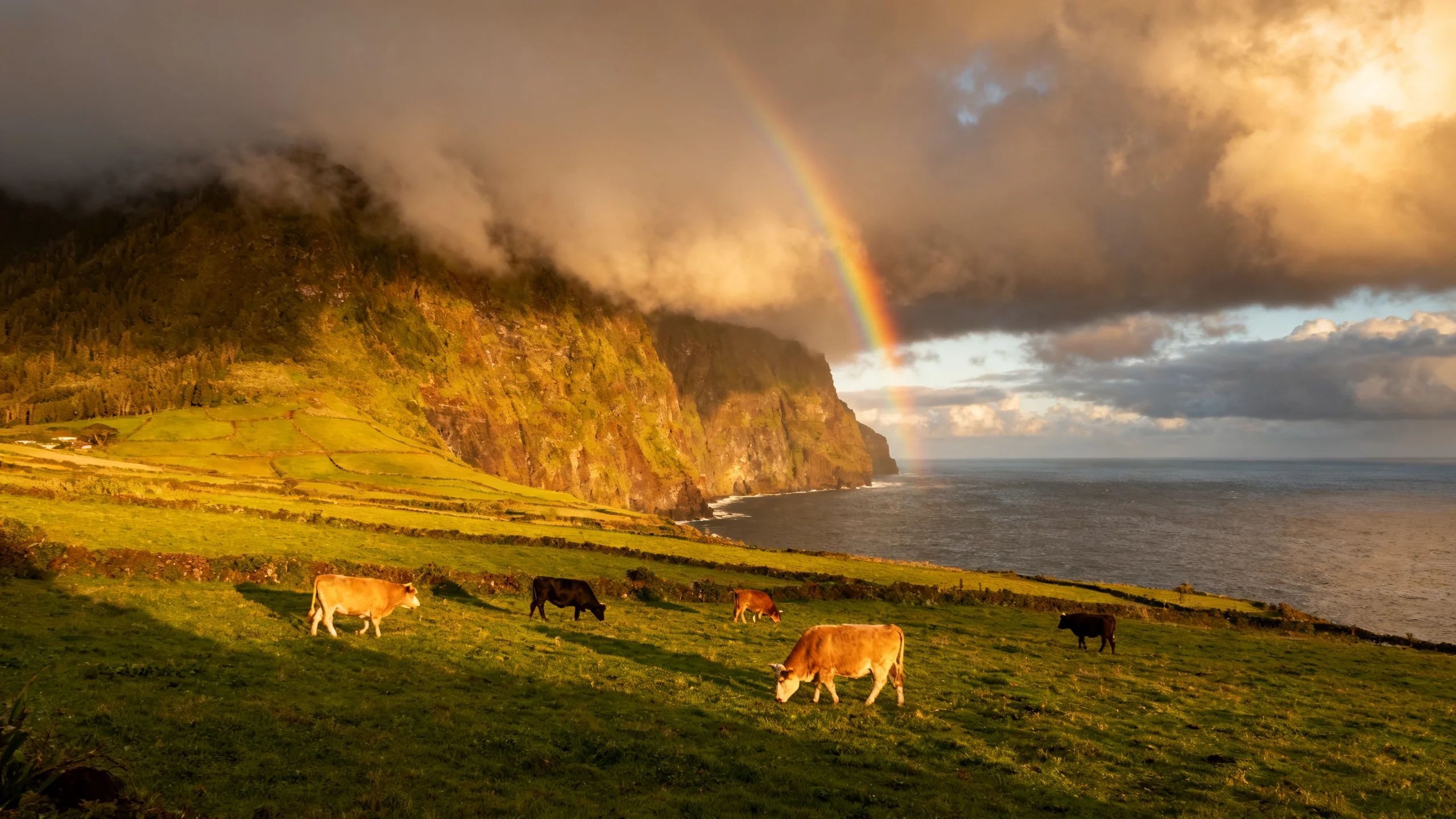
Real climate data for the nine islands. Temperature, rainfall, wind, sea conditions, microclimates, and the weather sites and forecasts that actually work.
The Azores has a maritime climate, moderated by the Gulf Stream and by sitting in the middle of the North Atlantic. The practical effect is moderate temperatures year-round (rarely below 10 °C or above 26 °C), high humidity, and weather that changes every few hours. People who come expecting Portuguese-mainland sunshine are often surprised. People who come expecting Irish gloom are also usually surprised.
This guide breaks down the actual climate, the seasonal patterns, the microclimates that matter on each island, and the forecast tools that locals use.
The numbers, by season
Ponta Delgada (São Miguel) is the canonical reference. Numbers are slightly cooler and wetter inland, slightly warmer and drier on the south coast.
| Month | High (°C) | Low (°C) | Sea (°C) | Rain days |
|---|---|---|---|---|
| January | 17 | 12 | 16 | 17 |
| February | 17 | 11 | 15 | 14 |
| March | 18 | 12 | 16 | 15 |
| April | 19 | 13 | 17 | 13 |
| May | 21 | 14 | 18 | 11 |
| June | 23 | 16 | 20 | 7 |
| July | 25 | 18 | 22 | 5 |
| August | 26 | 19 | 23 | 5 |
| September | 25 | 18 | 23 | 9 |
| October | 22 | 16 | 21 | 14 |
| November | 19 | 14 | 19 | 16 |
| December | 18 | 13 | 17 | 18 |
Source: IPMA (Portuguese Institute of Sea and Atmosphere) climatology 1991 to 2020 average.
What “rain days” actually means
A rain day in the Azores almost never means an all-day washout. The typical pattern is a fast-moving rain band lasting 30 minutes to 2 hours, separated by clear or partly cloudy windows. A “wet” day with 6 hours of sunshine and 3 short rain bands is common.
The practical implication: plan flexibly. If the morning is grey, the afternoon may be brilliant. If you skip a planned outdoor day because of the forecast, you may miss the only clear window of the afternoon.
Locals call this quatro estações em um dia (four seasons in a day). You will hear the phrase often. It is mostly accurate.
Wind, the underrated factor
The Azores is windier than people expect. Average winds are 15 to 25 km/h year-round, gusting to 40+ on exposed coasts. The wind shapes the trip more than the rain does.
- Comfort. A 22 °C sunny day with 30 km/h wind feels like 17 °C. Bring a windproof layer even in summer.
- Boat trips. Whale watching, dolphin watching, swim with dolphins and inter-island ferries get cancelled at moderate-to-fresh wind levels (Beaufort 5+). Always build a buffer day for activities with a marine component.
- Hair and hats. A chin-cord hat is not optional on the boat or on viewpoint platforms.
The prevailing wind is from the south-west in summer, north-west in winter. North-facing coasts are calmer in summer; south-facing coasts are calmer in winter.
Microclimates by island
The nine islands span 600 kilometres of ocean. They share the same general climate but differ in detail.
| Island | Rainfall vs São Miguel | Wind exposure | Notes |
|---|---|---|---|
| São Miguel | Reference | Moderate | South coast drier than north |
| Santa Maria | 30% less rain | Lower | The driest, sunniest island |
| Terceira | Similar | Moderate | Praia da Vitória drier than Angra |
| Faial | 10% more rain | Higher | Volcanic exposure |
| Pico | 20% more rain | High | Volcano captures cloud |
| São Jorge | 30% more rain | Higher | Ridge axis catches Atlantic fronts |
| Graciosa | 30% less rain | Lower | Dry, sometimes called Ilha Branca |
| Flores | 50% more rain | Higher | Wettest island, very green |
| Corvo | 50% more rain | High | Wettest, most exposed |
If you want maximum sun, go to Santa Maria or Graciosa. If you want the most lush green and the wildest weather, go to Flores or Corvo.
Within-island microclimates
The single biggest within-island climate difference is between the windward (north) and leeward (south) coasts, and between the rim plateaus and the coastal towns.
On São Miguel: Ponta Delgada (south coast, low altitude) is the warmest and driest. Lagoa do Fogo and Sete Cidades rims (575 to 800 m) are 4 to 6 °C cooler and noticeably cloudier. Furnas (sheltered valley) traps morning fog but clears by mid-morning.
On Pico: the volcano summit (2,351 m) is reliably cloud-capped unless you happen to catch a clear window. The south side (Madalena, São Roque) is significantly drier than the north (Lajes).
On Terceira: Praia da Vitória on the east coast is the warmest and driest spot on the island. Angra on the south-west is windier.
The forecast tools that work
The Azores has its own weather service and several site-specific forecasts. Locals use these, not Google’s default.
- IPMA (ipma.pt/en) is the Portuguese national meteorology service. The Azores section gives island-by-island 10-day forecasts. The marine forecast tab is the one to use for boat trip planning.
- Windy.com for visualising the wind field and the storm trajectories around the islands.
- MeteoAçores Facebook page for short-term local commentary in Portuguese.
Generic apps (Apple Weather, Google) draw from coarser models and often miss the localised microclimate. For surface conditions, trust IPMA. For 24-hour reading-the-sky locally, trust the locals you ask.
What to pack
The maritime climate demands layered clothing across all seasons.
| Layer | Summer (May to Sept) | Winter (Oct to April) |
|---|---|---|
| Base | T-shirt, shorts | Long-sleeve t-shirt |
| Insulating | Light fleece | Mid-weight fleece |
| Wind / rain | Windproof shell | Waterproof shell |
| Footwear | Walking shoes | Waterproof shoes/boots |
| Swim | Swimsuit | Optional |
| Accessories | Hat, sunglasses, sunscreen | Hat, sunglasses, sunscreen, gloves for high ground |
Sunscreen all year. The maritime UV reaches the skin even on cloudy days, and the Atlantic reflection multiplies it. SPF 50 in summer, SPF 30 in winter.
Frequently asked questions
Is the weather more reliable than Madeira?
Madeira is warmer (3 to 5 °C higher year-round) and drier overall. The Azores has cooler summers and more rain. If you want predictable sun, Madeira is the better bet. If you accept variable weather in exchange for less crowded islands and more dramatic landscapes, the Azores wins.
How cold does it get in winter?
Coastal winter lows are 10 to 13 °C, daytime highs 16 to 18 °C. Frost is essentially unknown below 400 m altitude. The Pico volcano summit can see brief snow in January and February. The rest of the archipelago does not have a real cold season by European standards.
Are there thunderstorms?
Rare. Thunderstorms occur maybe 5 to 10 days per year on most islands, typically in late summer when an unstable Atlantic low passes through. They are mostly offshore and short-lived. The bigger risk for outdoor activities is heavy rain bands (canyoning, hiking) and high wind (boat trips), not thunder.
Does the temperature vary much by island?
Not much. The nine islands are all within 1 to 2 °C of each other on a given day. Santa Maria runs slightly warmer, Flores and Corvo slightly cooler. The rain and wind vary more than the temperature.
What is the UV like?
Moderate to high in summer (UV index 7 to 9 on clear midday hours), moderate in shoulder season. The maritime air filters the UV less than continental air, so a “cloudy summer day” can still cause sunburn. SPF 50 for sustained outdoor activity in June to September, even when overcast.