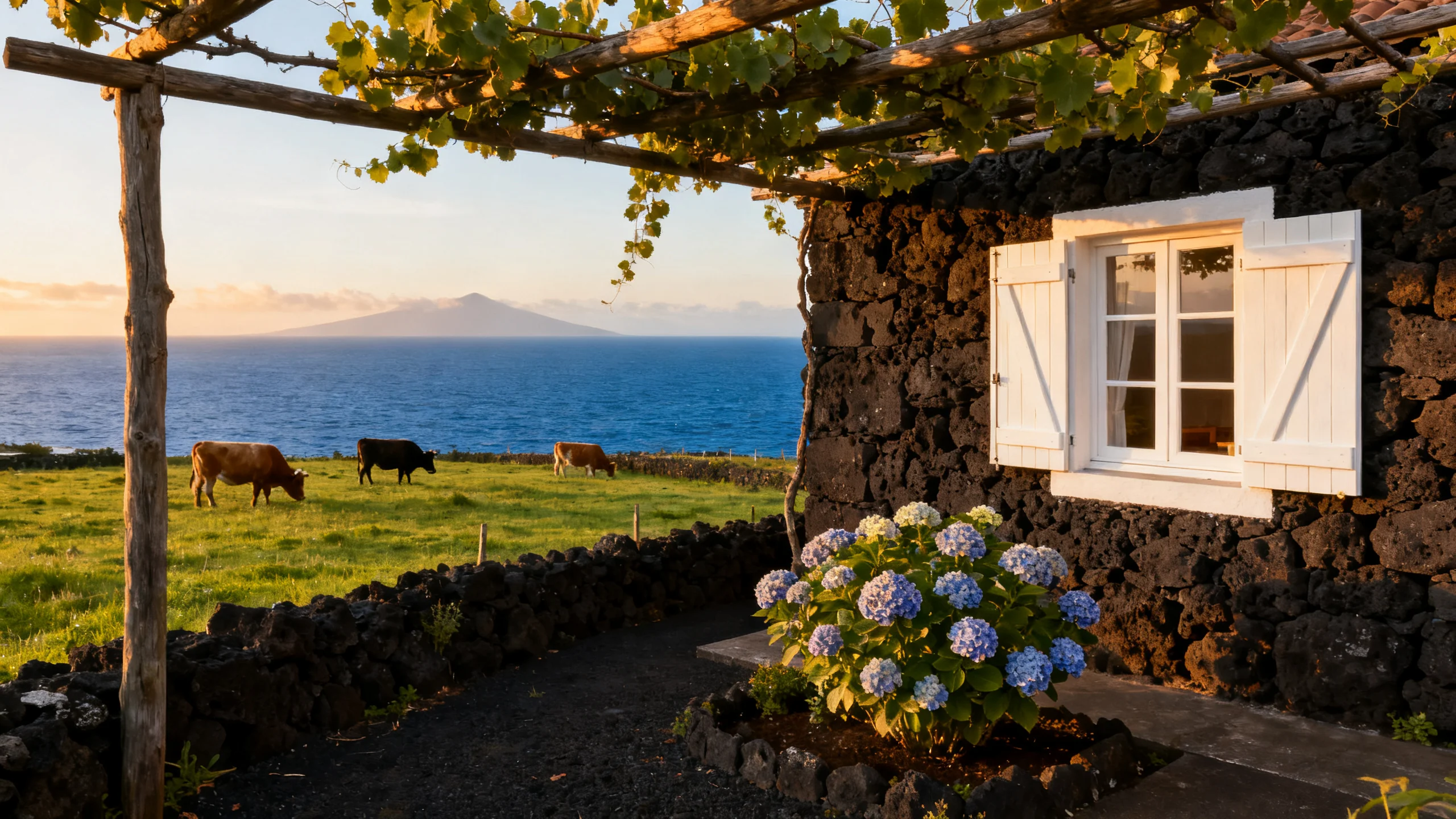
Restored stone farmhouses, agricultural quintas, and traditional Azorean cottages across the islands. The turismo rural certification, what to expect, and the standout properties on each island.
The Portuguese turismo rural certification system covers restored farmhouses, agricultural quintas, and traditional cottages let to visitors as accommodation. The Azores has one of the highest concentrations in Portugal: every island has at least a handful of certified properties, and São Miguel alone has over 200.
This guide explains what turismo rural actually means, what to expect from the typical property, and the standout casas rurais on each island.
What turismo rural actually is
Five sub-categories of rural accommodation are recognised by the Portuguese certification:
- Agroturismo: a working farm with rooms or cottages let to visitors. The farm income from the let supplements the agricultural income.
- Turismo rural: a restored rural property (not necessarily a working farm) of traditional Azorean architecture.
- Turismo de habitação: an aristocratic or otherwise notable historical house, with rooms let by the owners.
- Casa de campo: a country cottage or farmhouse, typically self-catering for 2 to 6 people.
- Hotel rural: a small countryside hotel (under 30 rooms) in a rural location.
For visitors, the categories matter less than the practical implications: rural properties are scattered across the islands, typically in restored stone buildings, often with gardens, and mostly outside the main towns. Most require a rental car.
What to expect
The average turismo rural property in the Azores:
- 2 to 8 rooms or cottages
- Restored traditional architecture (basalt stone, white walls, red-tile roofs, wooden shutters)
- Garden or small orchard
- 5 to 30 minutes’ drive from the nearest village restaurant
- Breakfast included (typically a local-products breakfast: tea from Gorreana, pineapple from local plantations, cheese from São Jorge, bread from the village bakery)
- Wifi (often slower than urban hotels, see the electricity and internet guide)
- No pool (most properties), the sea or a thermal pool is the swim
Most do not have on-site restaurants. Dinner means a drive into the nearest village. Most owners can recommend (and sometimes book) local restaurants.
Standout properties by island
São Miguel
Aldeia da Fonte Azorica (south coast). A cluster of 12 restored stone cottages on a cliff above the sea, near Vila Franca do Campo. €140 to €220 per night, 2-bedroom cottages. Spa, restaurant on site.
Quinta da Verdejada (near PDL). A working pineapple plantation with 4 cottages, garden access, breakfast from the farm. €110 to €170 per night.
Pico
Aldeia da Fajã (north coast). Restored stone cottages directly within the UNESCO Lajido vineyard zone. €130 to €200 per night per cottage. Walking distance to the wine museum, vineyard tour operators on site.
Casas Açorianas Pico. A portfolio of single-cottage rentals across the island, managed centrally. Best for travellers wanting a specific architecturally distinctive cottage. €90 to €180 per night.
Faial
Quinta do Cisne (Castelo Branco). A small family-run estate on the south coast, 6 rooms with garden access, breakfast from the farm. €110 to €170 per night.
São Jorge
Casa do Surfista (Fajã da Caldeira de Santo Cristo). A surfer’s cottage on a trail-only fajã, 4 simple rooms, €50 to €70 per night including breakfast. The descent to the fajã is part of the experience.
Terceira
Quinta dos Açores (near Biscoitos). A working dairy farm with 4 stone cottages and an on-site ice-cream factory. €100 to €140 per night.
Flores
Aldeia da Cuada. A genuinely restored 19th-century village, abandoned in the 20th century and rebuilt as 12 boutique cottages in 2005. The whole village is the accommodation. €110 to €180 per night, breakfast included.
Casa do Penhasco (Fajã Grande). A 4-room boutique guesthouse on the cliff above Fajã Grande, the most dramatic location on the island. €120 to €180 per night.
Graciosa, Corvo, Santa Maria
The smaller islands have fewer rural properties overall. On Graciosa, the small village guesthouses in Santa Cruz substitute for traditional turismo rural. On Corvo the single small B&B in Vila do Corvo is the only option. On Santa Maria, several small estates inland (Quinta da Verdejada Santa Maria, and the small quintas near Santo Espírito) operate as turismo rural with €80 to €140 nightly rates.
São Jorge
Quinta do Galo (Calheta). Rural estate just inland from Calheta with 4 rooms and a working farm. €90 to €140 per night, breakfast from the farm included.
Price ranges by category
| Category | Typical range / night | What you get |
|---|---|---|
| Casa rural (1 to 2 rm) | €70 to €130 | Restored cottage, breakfast, basic kitchen |
| Casa de campo (whole house) | €100 to €200 | Self-catering, 2 to 6 people, garden |
| Boutique rural (4 to 8 rm) | €130 to €220 | Restored hotel, restaurant, polished service |
| Working agroturismo | €90 to €170 | Working farm, fresh-from-farm breakfast |
| Premium rural | €180 to €320 | High-end restoration, spa, private terrace |
Practical booking notes
- Book by season. Most turismo rural properties have clear high-season (July-August) and shoulder-season pricing. The shoulder season (May-June and September-October) often offers the same room at 25 to 40% below summer prices.
- Minimum stays. Several properties enforce a 2 or 3-night minimum, especially in summer. Check before committing.
- Cancellation policies. Generally stricter than urban hotels. Some cottage rentals require 30 days notice; the typical guesthouse uses 7 to 14 days.
- Self-catering provisioning. The smaller-island casas rurais may be far from any supermarket. Buy provisions in the nearest town before driving up to the property.
- Wifi reality. Most rural properties have wifi but it can be slower than urban hotels. If sustained remote work matters, ask before booking. See the electricity and internet guide.
See the where to stay in São Miguel and the other island where-to-stay pages for the per-island detail.