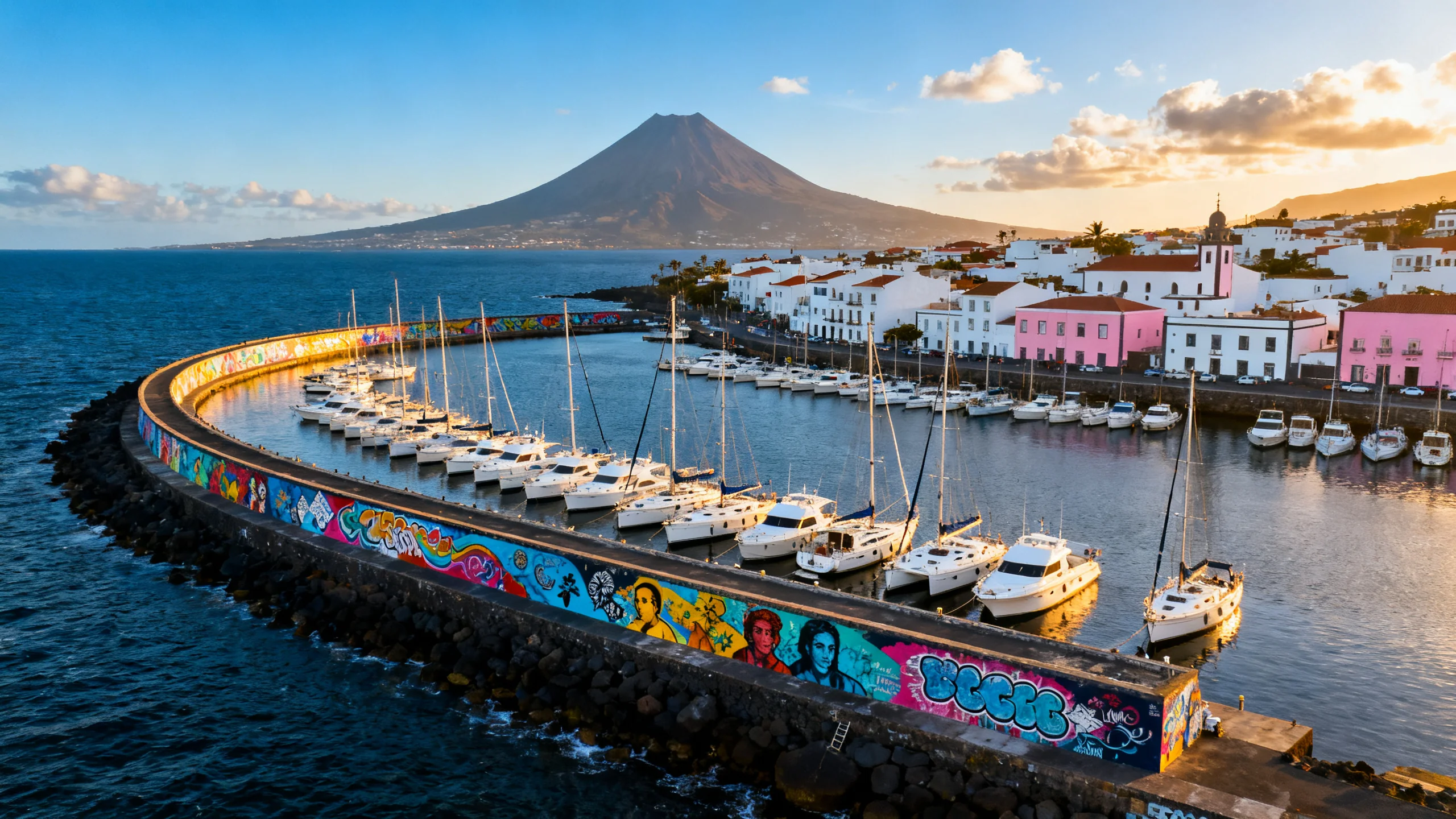
Faial is a small, round, central-group island built around a single great caldera at its centre and the marina of Horta at its eastern edge. Horta is the legendary stopover for transatlantic sailors crossing east or west, the harbour walls covered in painted murals from thousands of crews. The Capelinhos volcano site on the western tip, where an underwater eruption in 1957 to 1958 added new land to the island, is the most recent surface volcanism in Europe.
Faial is the second-smallest of the central group, but its harbour of Horta is the busiest cruise and yacht stop in the Atlantic mid- ocean. The island is essentially a single great volcanic caldera at the centre, with the Capelinhos eruption site on the west and the town of Horta on the east. The Pico volcano rises directly across the channel, a 30-minute ferry away.
This guide covers what to expect, when to come, what to do, where to base, and how to plan a stay of 2 to 4 days.
Why Faial
Faial is the right pick for travellers who want a small, walkable island base with one extraordinary harbour town, the most recent European volcanism on a single half-day, and ferry-easy access to Pico. It works well as a 3 to 4 day standalone destination or as half of a 7-day Pico + Faial combination.
It is the wrong pick for travellers who want range. The whole island can be driven around in 2 hours. The list of major attractions is short. The trade-off is depth: Horta itself is genuinely distinctive, the Capelinhos site is the only place in Europe where you can walk on land that did not exist a lifetime ago, and the Caldeira rim trail is one of the great Atlantic hikes.
Geography and climate
Faial is roughly circular, 21 km across at its widest. The Caldeira do Faial (1,043 m, two kilometres in diameter) dominates the interior. The Capelinhos peninsula on the west is a flat black-sand extension built by the 1957 to 1958 underwater eruption; before that, the island ended a kilometre east of where it does today.
Horta on the east coast is the main town and the only ferry port. The island ring road is 70 kilometres total.
The climate is wetter than São Miguel (around 10% more rainfall on average) and slightly cooler. The Caldeira rim is reliably cloudier than the coast. Horta itself is sunny in summer and mild in winter.
Top experiences on Faial
Horta marina. The most famous yacht port in the mid-Atlantic. The 2-kilometre harbour wall is covered with painted murals left by thousands of crews crossing east or west since the 1980s; the tradition is to paint a panel before leaving harbour for good luck. See the Capelinhos and Horta guide for the detailed walking circuit.
Peter Café Sport. The sailor bar at the marina entrance, in continuous operation since 1918. The walls are covered in burgees, flags, and bottles left by visiting crews. The gin and tonic is the ritual order. Upstairs, the small whaling museum (Museu de Scrimshaw) holds one of the best private scrimshaw collections in the world.
Capelinhos volcano site. The 1957 to 1958 underwater eruption added a new peninsula to the western tip of the island. The half- buried lighthouse, the protected lava plain, and the visitor centre built into the lighthouse explain the event. The most recent land in Europe. Half-day visit. See the Capelinhos and Horta guide for the full walking route.
Caldeira do Faial rim trail. A 7-kilometre loop along the rim of the central caldera at 1,000 m altitude. Continuous panoramic views (when cloud cooperates) over the western and northern coasts. Allow 3 hours including stops. Trailhead access via the EN3 from Horta, 25 minutes’ drive.
Whale and dolphin watching from Horta. Faial’s south-west coast faces the same deep-water corridor as Lajes do Pico. Sperm whale sightings are reliable year-round. The research whale and dolphin expedition from Horta is the scientific option, 4-hour trip with a marine biologist on board, around €90. See the whale watching activity guide for full operator comparison.
Ferry day trip to Pico. The 30-minute Horta-Madalena crossing runs 8 to 10 times daily in summer. A 9am ferry and a 6pm return gives you a full day on Pico: wine museum, Lajido walk, lunch. €4.30 each way. Functionally Pico and Faial are a twin destination.
Cabeço Gordo summit. A short 30-minute hike from the rim trail to the highest point on the island (1,043 m). The view from the top includes São Jorge, Pico, Graciosa, and on a clear day the western horizon of the open Atlantic.
Where to base yourself
Horta is the only realistic answer. The town concentrates the restaurants, the marina, the ferry terminal, the airport (5 minutes away), and most accommodation. Drive times from Horta: 25 minutes to the Caldeira trailhead, 25 minutes to Capelinhos, 5 minutes to the airport.
Rural casas exist in the smaller villages of the south coast and the eastern coast (Castelo Branco, Feteira), but the difference in quiet vs distance is small on an island this size.
The dedicated where to stay on Faial guide breaks the choice down by area, profile, and budget.
Getting to Faial
Faial Airport (HOR) has:
- Lisbon (LIS): TAP, 4 to 6 weekly, 2h30. Year-round.
- Terceira (TER): SATA, several daily, 30 minutes.
- São Miguel (PDL): SATA, daily, 50 minutes.
- Pico (PIX): SATA, occasional, 10 minutes. The ferry is usually faster and cheaper.
The Atlanticoline ferry between Horta and Madalena (Pico) runs 8 to 10 times daily in summer, 30 minutes, €4.30 each way. The ferry is the right answer for travellers combining Faial with Pico.
For non-European arrivals, the cleanest pattern is to fly into PDL (São Miguel) or LIS (Lisbon) and connect to HOR.
A dedicated guide on how to get to Faial covers airlines, the ferry triangle, and onward connections.
Getting around
A rental car covers the island in 2 hours of driving. For a 2 to 3 day stay, you may not need one if you base in Horta: the town is walkable, Capelinhos is reachable by taxi or tour, and the Caldeira rim has bookable guided shuttle services.
For a 4-day stay, the rental car becomes useful for the smaller villages and the back roads of the south coast. €25 to €60 per day from Ilha Verde or Autatlantis at the airport.
Suggested itineraries
2 days, focused. Day 1: arrival, afternoon walk through Horta marina and dinner at Peter Café Sport. Day 2: morning at Capelinhos volcano site, afternoon Caldeira rim trail, evening ferry to Pico for dinner or back to Horta.
3 days, full island. Days 1 to 2 as above. Day 3: whale watching from Horta morning, day trip to Pico in the afternoon.
4 days, Pico-Faial combination. Days 1 to 3 on Faial as above. Day 4: full day on Pico (wine museum, Lajido walk, dinner in Madalena before the last ferry).
Best time to visit
- May to June: the best window. Hydrangeas starting, Caldeira visible on most days, ferry to Pico running on full schedule.
- July to August: peak season, Semana do Mar in the first week of August, full ferry service, busiest accommodation.
- September to October: quieter, water still warm, whale sightings reliable. Prices dropping.
- November to April: off-season. Some restaurants closed, ferry schedule reduced to 4 to 6 daily, but the Horta marina and the Capelinhos site are open year-round.
Frequently asked questions
Is Faial worth visiting if I am not a sailor?
Yes. The Horta marina is the headline attraction even if you have never sailed; the painted-mural tradition and the Peter Café Sport atmosphere are unique. The Capelinhos volcano site is interesting to anyone who wonders what new land looks like, and the Caldeira rim is a great walk regardless of your maritime interests. Sailors find extra depth here; everyone else still finds a worthwhile 2 to 3 day visit.
Should I paint a mural on the harbour wall?
The tradition is for the crew of a vessel that has crossed (or will cross) an ocean to leave a panel before sailing. Local etiquette discourages tourists from painting purely decorative or holiday- trip murals, since they crowd out the genuine crew panels. If you are sailing through, ask at Peter Café Sport for paint and brushes; they keep both. Otherwise, photograph the existing murals and let the wall stay a sailors’ wall.
How does Faial compare to Pico?
Faial is smaller, more urban-feeling, more focused on a single port town. Pico is larger, more geological, with more hiking and wine. Many travellers visit both via the ferry triangle and find them complementary. If you can only do one, choose Faial for the marina or Pico for the volcano and wine.
Is Capelinhos still active?
No. The 1957 to 1958 eruption ended cleanly and the site has been geologically quiet since. The cooled ash and lava are now a protected geological reserve, slowly eroding back into the Atlantic. The visitor centre and walking trails are entirely safe.
Why is Faial called the "blue island"?
The blue hydrangeas (hortensias) that grow in dense hedges along nearly every road on the island in summer. The volcanic-acid soil intensifies the blue colour, and Faial’s hedges are particularly spectacular in July. The nickname (Ilha Azul) has stuck since the mid-19th century.