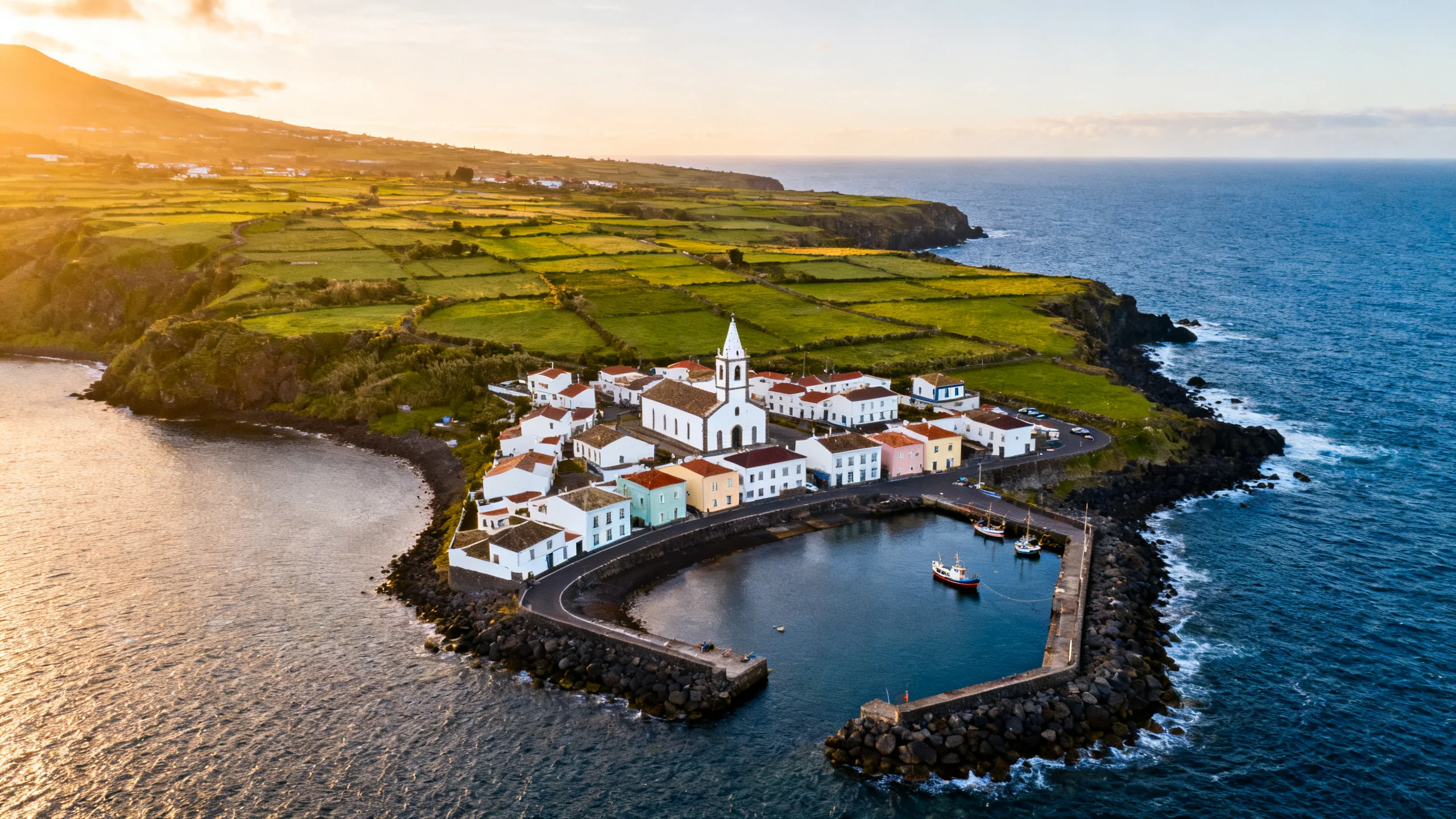
Graciosa is the smallest of the central group and the quietest of the Azorean islands. The shape is a low oval, the central feature is a 1-kilometre-wide caldera with the underground sulphur cavern of Furna do Enxofre at its base, and the surrounding plateau is dotted with traditional windmills and DOP-protected vineyards. The whole island has been a UNESCO Biosphere Reserve since 2007.
Graciosa is the smallest of the central-group islands and the most overlooked. The shape is a low oval roughly 12 kilometres by 7, with no high peaks and only one volcanic caldera at its centre. The population of just over 4,000 lives spread across a handful of small villages, mostly around the southern coast. The whole island has been a UNESCO Biosphere Reserve since 2007.
This guide covers what to expect, why the visit is mostly about one genuinely distinctive site, and how to plan a 2 to 3 day stay.
Why Graciosa
Graciosa rewards travellers who want quiet. The whole island sees fewer visitors in a year than São Miguel sees in a single peak week. You can drive the entire ring road in an hour, walk the small capital end to end in 20 minutes, and meet more cows than people on the inland roads.
The signature reason to come is Furna do Enxofre, the 220-metre sulphurous cavern at the bottom of the central caldera. Nothing quite like it exists anywhere else in Europe. If the cavern alone is worth the trip is a personal call; for most visitors it is the deciding factor.
Beyond the cavern, the island offers the working windmills, the DOP white wines, the coastal pools at Praia, and the genuine pleasure of a place where the tourism economy has not arrived yet. It is the wrong pick for travellers who want range, restaurants, beaches, or hiking depth. It is the right pick for solitude.
Geography and climate
Graciosa is a low-relief island, the smallest in surface area of the central group. The highest point is the rim of the central Caldeira at 405 metres. The five small villages are scattered around the coast:
- Santa Cruz da Graciosa (the capital, north coast, 2,000 hab.)
- Praia (the second town, south coast, 1,000 hab.)
- Guadalupe, Luz, São Mateus (smaller, all under 500 hab.)
The climate is the driest in the central group (around 30% less rainfall than São Miguel). The reduced cloud cover is why the island reads “white” rather than the green of the rest of the archipelago. Summer is warm and sunny; winter is mild and quieter.
Top experiences on Graciosa
Furna do Enxofre. The 220-metre-deep sulphurous cavern at the base of the central Caldeira. Descended via a spiral staircase from a small visitor centre on the rim. Inside, an underground lake flanked by fumaroles emitting sulphurous gases, basalt walls discoloured by mineral staining. The only cavern of its kind in Europe. Access by guided tour only. See the Furna do Enxofre detailed guide for the visit logistics.
Caldeira rim trail. A 7-kilometre loop around the rim of the central caldera at 400 metres altitude. Continuous views over the small interior of the island and the surrounding Atlantic. Trail- marked as PR 1 GRA, well-maintained. Allow 2.5 hours including stops. The trailhead is at the Furna do Enxofre visitor centre.
Santa Cruz da Graciosa walking circuit. The small capital is walkable end-to-end in 20 minutes. The main square (Praça Fontes Pereira de Melo), the Igreja Matriz church, the small Museu da Graciosa with its ethnographic collection, the seafront promenade with the natural harbour. 90 minutes of slow walking covers everything; coffee at the Café Central finishes the morning.
Praia coastal pools. A series of natural pools cut into the black lava rock at Praia village on the south coast. Swimmable in summer, sheltered from the swell by basalt outcrops. Free, no facilities, very local atmosphere. The right place for a mid-afternoon swim.
Traditional windmills. Two restored working windmills remain on the island, one at Pedras Brancas and one near Praia. Both have the distinctive Graciosan red-painted sails and the cylindrical stone tower. The Pedras Brancas mill can be visited inside on weekends and during summer.
Graciosa DOP wines. A small wine industry produces Verdelho- based dry whites grown on volcanic soil around the southern villages. The Adega Cooperativa near Praia offers tastings (€5 to €10) and direct sales (€8 to €15 per bottle). Less famous than Pico DOP but worth a stop.
Where to base yourself
Santa Cruz da Graciosa is the practical answer. Most accommodation, the few restaurants, the airport 5 minutes away, and walking access to the small museum and the seafront. Drive times from Santa Cruz: 15 minutes to Furna do Enxofre, 15 minutes to Praia.
Praia is the alternative on the south coast, smaller but with the beach pools and the windmills nearby. Limited dining choice.
The dedicated where to stay on Graciosa guide breaks down the options.
Getting to Graciosa
Graciosa Airport (GRW) is small. Direct service is limited:
- Terceira (TER): SATA, 4 to 5 weekly, 20 minutes. The main connection.
- São Miguel (PDL): SATA, 2 to 3 weekly, 45 minutes via TER.
- Lisbon (LIS): TAP, occasional summer charters only.
There is no direct international service. The standard routing is via Terceira (fly into TER from Boston or Lisbon, then 20-minute inter-island flight to GRW). Summer-only Atlanticoline ferries from Terceira and São Jorge run a few times per week, weather-dependent.
See how to get to Graciosa for the detailed connection options.
Getting around
A rental car is recommended though not strictly essential. The ring road is 25 kilometres, drivable in an hour. The island is small enough that taxis from Santa Cruz can cover most visitor needs for under €15 per ride. Bicycle rental works in summer if you do not mind the gentle hills.
Companies: a small local fleet at the airport, €25 to €60 per day. Reserve in advance; the fleet is genuinely small.
Suggested itineraries
2 days, focused. Day 1: arrival, walk Santa Cruz, lunch in town, afternoon at Furna do Enxofre and the Caldeira rim trail. Day 2: drive to Praia, coastal pools morning, windmill at Pedras Brancas, lunch at the cooperative, afternoon at the south-coast villages.
3 days, comprehensive. Days 1 to 2 as above. Day 3: ridge walk around the lesser-trafficked north and east of the island, lunch at a rural restaurant in one of the smaller villages, evening flight out.
Best time to visit
- May to September: the warmest and driest months. Furna do Enxofre cave is open daily, coastal pools at Praia are swimmable.
- October to April: the cavern visit hours reduce, several small guesthouses close. The trip becomes a one-attraction visit rather than a multi-day exploration.
Frequently asked questions
Is Graciosa worth a dedicated visit?
It depends on your tolerance for small islands. If you want ten-things-to-do tourism, no. If you want one extraordinary site (Furna do Enxofre) plus 2 to 3 days of quiet rural Azorean life, yes. Many central-group travellers fly into TER, do São Jorge or Pico for the main trip, and add Graciosa as a 2-day side stop. The inter-island flight is short and cheap enough that the add-on makes sense.
How accessible is Furna do Enxofre?
Reasonably accessible. The visitor centre is at the rim of the Caldeira on a paved road. The descent into the cavern is via a metal spiral staircase with handrails, 184 steps down, 184 back up. Not technically difficult; just demanding for travellers with mobility issues or fear of enclosed spaces. The cavern air smells distinctly of sulphur (rotten egg) but is monitored continuously for safety.
How does Graciosa compare to the other small islands?
Graciosa is drier and sunnier than Flores or Corvo, with more windmills and more agricultural pasture but fewer waterfalls. It is less famous than Santa Maria (the southern island with the beaches). Of the small islands, Graciosa is the most “sleepy interior” option; Flores is the most dramatic landscape; Santa Maria is the most beach-oriented; Corvo is the most genuinely remote.
Can I combine with another island?
Yes. Terceira is the natural partner (the SATA flight is 20 minutes). The classic pattern is Boston direct to TER, 4 to 5 days on Terceira, 2 days on Graciosa, fly out via TER. Adding Graciosa to a central-group triangle (Pico + Faial + São Jorge) is also possible but logistically tighter; allow 10 to 12 days for the 4-island combination.
Why is Graciosa called the "white island"?
The chalky white volcanic tuff soil that covers much of the central plateau, plus the predominantly whitewashed traditional architecture of the villages. Graciosa reads paler than the other Azorean islands from a distance. The nickname (Ilha Branca) is descriptive rather than evocative.