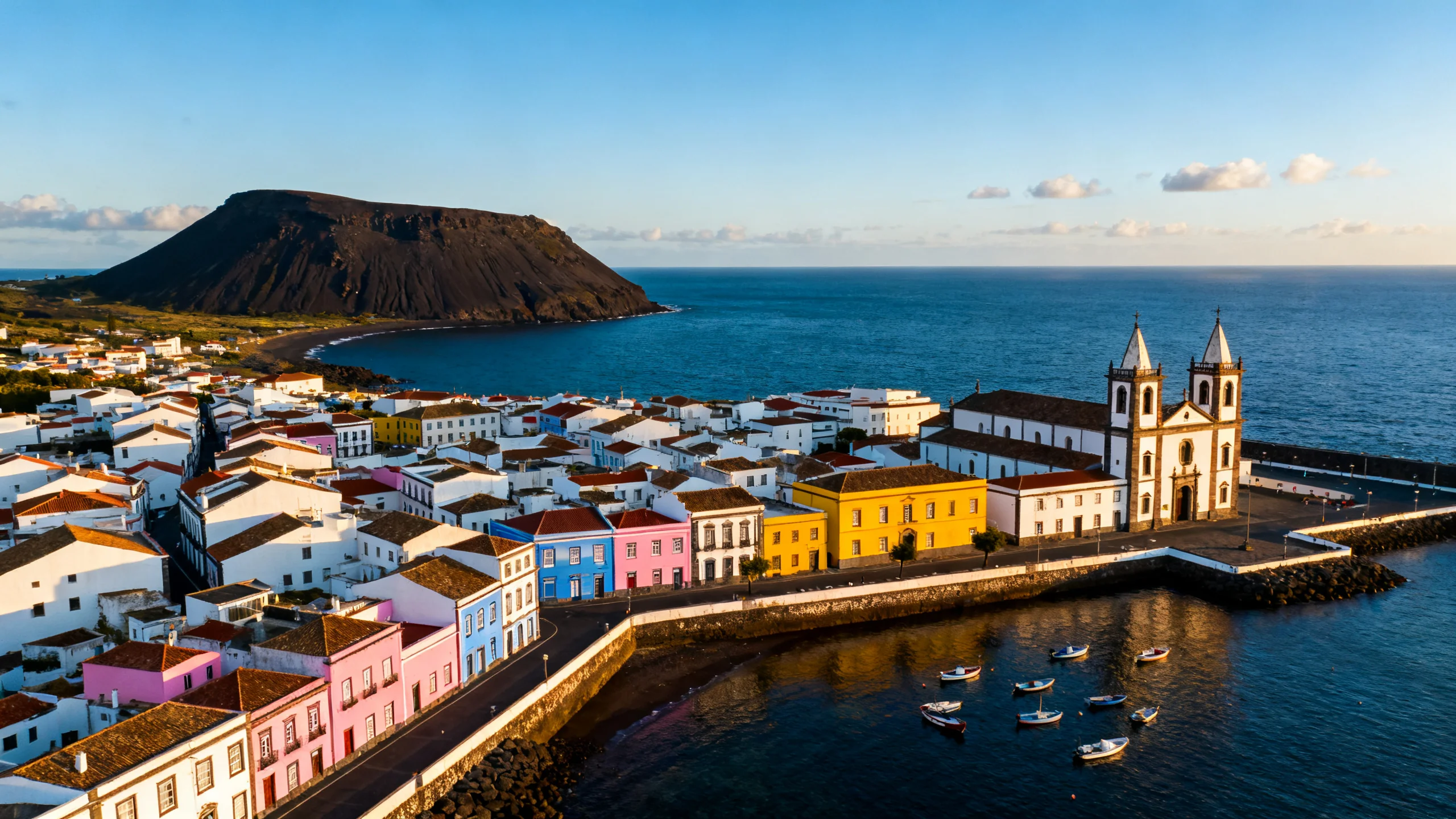
Terceira is the third Azorean island by size and second by visitor traffic. Its centre is Angra do Heroísmo, a UNESCO World Heritage city of pastel-painted houses, baroque churches, and a 16th-century military harbour. Beyond Angra the island opens into volcanic interior plateaus, the famous Algar do Carvão lava cavern, the bull-running festivals that no other island matches, and a coastline of black-rock beaches and surf.
Terceira is the third-largest Azorean island by area and the second by visitor numbers. Its centre is Angra do Heroísmo, a small UNESCO city that was the strategic Atlantic port of the Portuguese empire for two centuries. Outside Angra, the island spreads into volcanic plateaus, a 90-metre-deep lava cavern, a long stretch of black-sand beach, and the most distinctive cultural calendar in the archipelago.
This guide covers what to expect, when to come, the things worth your time, and how to plan a stay of three to five days.
Why Terceira
Terceira has a different texture from São Miguel. Less green, more historical. Less driving, more walking inside the small city centre. Different food (the slow-roasted alcatra is the local specialty), a different festival calendar (the May to October tourada à corda running bulls every weekend), and direct flights from Boston that some travellers find more convenient than the São Miguel routing.
It is the right choice for travellers interested in baroque architecture, Portuguese imperial history, or summer festivals. It is less convenient for travellers focused on whale watching, hiking, or the iconic crater-lake landscapes (São Miguel and Pico do that better).
If you have one week and want one island, São Miguel still wins. If you have ten days and want two islands, Terceira plus São Miguel covers the cultural and natural sides of the archipelago well.
Geography and climate
Terceira is roughly oval, 30 kilometres by 18 kilometres. Five volcanic complexes form the topography: Serra de Santa Bárbara (the highest, 1,021 m, on the west), the Pico Alto stratovolcano in the centre (which hosts the Algar do Carvão), and three lower massifs on the east. The interior is a high plateau at 500 to 700 metres altitude, often cloud-covered.
The two main coastal cities sit at opposite ends. Angra do Heroísmo on the south coast is the old capital and the UNESCO centre. Praia da Vitória on the east coast is the modern town, built around the Lajes air base and the longest natural beach in the archipelago.
Climate is maritime-mild: 17 °C winter highs, 25 °C summer highs, moderate rainfall (1,000 to 1,400 mm/year). The east coast (Praia da Vitória) is notably drier and sunnier than the western interior.
Top experiences on Terceira
Angra do Heroísmo old town. The UNESCO-listed historic centre is walkable in a half-day. The Sé cathedral, the Castelo de São Sebastião, the pastel-painted streets, the Monte Brasil promontory walk for a panoramic view of the harbour. Slow lunch in a tasca, dinner in one of the modern bistros around Praça Velha. See Angra do Heroísmo for the detailed walking route.
Algar do Carvão. A 90-metre-deep volcanic chimney in the centre of the island, descended via a spiral staircase. The basalt walls and the underground lake at the bottom are unlike anything else in the Azores. Open year-round, €10 entry. Allow 90 minutes.
Tourada à corda. Terceira’s traditional bull-running festival, held in village squares from May to October. The bull runs on a long rope, six or eight men hold the rope, locals dodge the bull through the village streets. Not for everyone (ethically controversial, genuinely dangerous), but a cultural fixture that has not faded. Schedule via visitazores.com.
Sanjoaninas (June). The Azores’ biggest summer festival, two weeks of parades, bullfights, concerts, food stalls, and free public events. Centred on Angra do Heroísmo, mid-June. Book accommodation months ahead.
Whale watching from Angra. The Terceira whale and dolphin watching boat tour runs from Angra’s harbour. Less crowded than the São Miguel boats, similar species mix, often calmer sea on the south-Terceira side. Around €70.
Swimming with wild dolphins. Terceira offers the same Atlantic in-water encounter as São Miguel, via the Terceira swim with wild dolphins trip from Angra. Around €125, 4.8 rating.
Biscoitos. A small village on the north coast, famous for its DOP white wines grown on lava-stone walled vineyards, and for the black-rock coastal pools where locals swim in summer. The Museu do Vinho dos Biscoitos is open year-round.
Serra de Santa Bárbara rim trail. The summit caldera of the island’s highest volcano. A 7-kilometre loop trail circles the rim at 1,000 m altitude, with continuous views over the western half of the island when cloud cooperates.
Where to base yourself
Angra do Heroísmo is the obvious base. Most accommodation, restaurants, walking access to the UNESCO centre, departure point for whale-watching trips. Drive times: 25 minutes to Algar do Carvão, 45 minutes to Praia da Vitória, 40 minutes to Biscoitos.
Praia da Vitória is the alternative on the east coast. Larger modern hotels, beach access, closer to the airport. Less historical character. Suits beach-first travellers and families.
Rural quintas scattered across the interior offer the quietest option, especially around the Biscoitos wine area or the village of São Sebastião in the south.
The dedicated where to stay on Terceira guide breaks down the choice by area, profile, and budget.
Getting to Terceira
Direct international flights to Lajes Airport (TER):
- Boston (BOS): SATA Azores Airlines, 3 to 5 weekly year-round. The most useful direct route for North American travellers.
- Lisbon (LIS): TAP and SATA, several daily, 2h15.
- Porto (OPO): TAP, 3 to 5 weekly, 2h.
- Seasonal European charters (Frankfurt, Düsseldorf, summer only).
Inter-island connections:
- São Miguel (PDL): SATA, several daily, 35 minutes.
- Faial (HOR), Pico (PIX), São Jorge (SJZ): SATA, daily, 30 to 50 minutes.
- Flores, Santa Maria, Graciosa, Corvo: SATA, less frequent.
For non-EU travellers, the Boston-to-Terceira direct is often the cheapest gateway into the archipelago, sometimes 30 to 40% below the equivalent São Miguel routing.
A dedicated guide on how to get to Terceira covers airlines, schedules, and connection logic.
Getting around
Terceira is best explored with a rental car. The ring road around the island is about 90 kilometres and can be driven in 2 hours without stops. The interior plateau roads add another 30 kilometres of scenic driving.
The local bus network (ETAP) runs frequently between Praia da Vitória and Angra do Heroísmo (every 30 minutes on weekdays, less frequent at weekends). Other lines are tied to school schedules and less practical for visitors.
For travellers without a car, taxis and pre-booked transfers are the realistic answer for interior destinations like Algar do Carvão. Walking is enough inside Angra.
Suggested itineraries
3 days, first time. Day 1: arrival, afternoon walk through Angra UNESCO centre. Day 2: morning at Algar do Carvão and Furnas do Enxofre, afternoon at the Biscoitos coastal pools. Day 3: Serra de Santa Bárbara rim trail morning, whale-watching afternoon from Angra.
5 days, full coverage. Days 1 to 3 as above. Day 4: swim with wild dolphins from Angra, evening at Praia da Vitória beach. Day 5: slow day, Angra museums (Museu de Angra, Forte de São João Baptista), dinner in one of the gourmet bistros.
Best time to visit
- May to June: the most stable weather, the Sanjoaninas, the first tourada à corda dates. The best window for a full-island trip.
- July to August: peak season, warmest sea, all touradas running. Praia da Vitória beach at its best.
- September to October: quieter, water still warm, touradas finishing, harvest at the Biscoitos vineyards.
- November to April: off-season. Mild but rainy, smaller hotels close for the winter. Worth visiting only for the UNESCO architecture and the cultural museums.
Frequently asked questions
Is Terceira a good alternative to São Miguel?
It is a different island, not a substitute. Terceira excels at history, festivals, and Boston direct flights. São Miguel excels at crater lakes, whale watching, and concentrated natural landscapes. For a first-time Azores visitor, São Miguel still wins. For a second visit or for a culture-focused trip, Terceira is the right pick.
Are the bull runs (tourada à corda) safe to watch?
The crowd is in the village streets, separated from the bull by several rope-holders and barricades. The bull’s rope limits its range but does not prevent it. Watch from a balcony, a window, or from a side street rather than the main run. Locals know the patterns; tourists should stay back and follow the local lead. Injuries to spectators occur every season, mostly minor.
Is the Algar do Carvão suitable for children?
Yes, from around age 6. The descent is via a metal spiral staircase with handrails. The cavern is well-lit, the air is cool (around 14 °C year-round), the floor is dry. No genuine technical difficulty; just the 90-metre vertical descent and climb back up.
Can I combine Terceira with another island in a single trip?
Easily. SATA inter-island flights from Terceira reach São Miguel (35 min), Faial (30 min), Pico (35 min), and São Jorge (30 min) multiple times daily. The classic two-island combination is Terceira plus Faial-and-Pico (via the central-group ferry triangle). Allow 7 to 10 days for a comfortable two-island trip.
Why is Terceira called the "lilac island"?
From the lilac-coloured Azorean heather (Erica azorica) that covers the high-altitude interior of the island in autumn. Each of the nine islands has a traditional colour nickname; Terceira’s is “ilha lilás”. You see the heather best on the Serra de Santa Bárbara rim trail between September and November.